Cutting Bank Fees in 2025: The 15-Minute Call That Saves $400 a Year
Most bank fees charge you for inertia, not service. A 15-minute call on which are negotiable can save $400 a year.
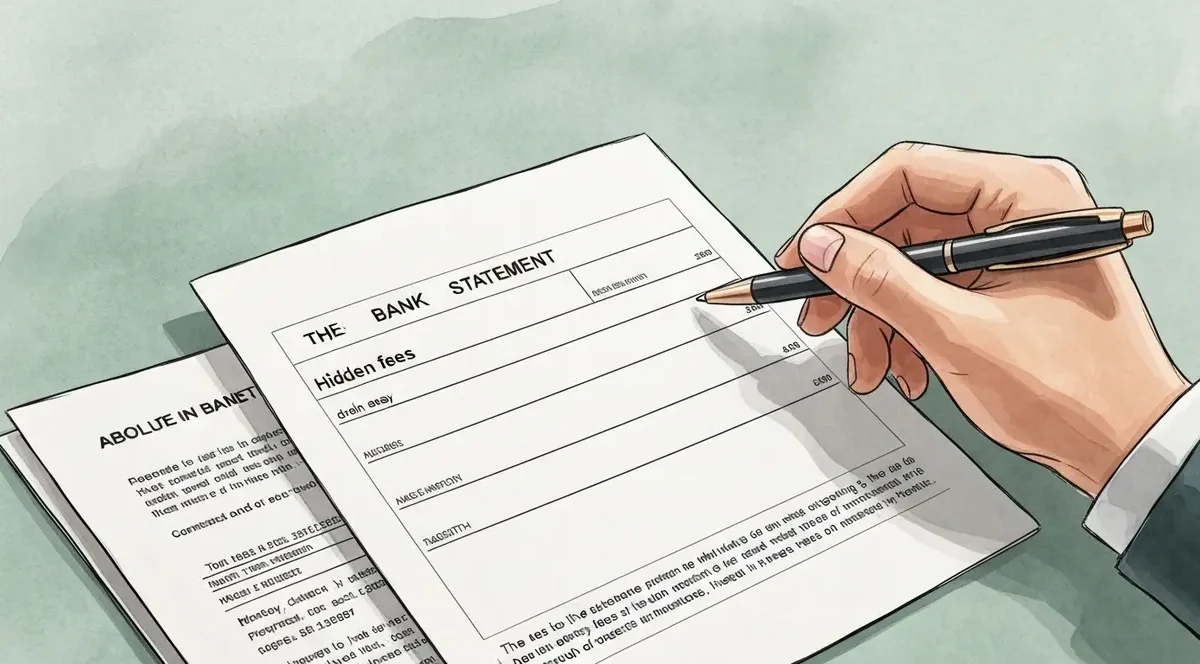
A bank fee is less like a price tag and more like a subscription you forgot you signed up for. Cutting bank fees in 2025 starts with admitting that most of what you pay isn’t for service rendered, it’s for inertia. The bank counts on you not calling, not switching, not reading the fee schedule. That math has worked in their favor for decades.
Here’s what changed this year: the Consumer Financial Protection Bureau finalized a rule in December 2024 capping overdraft fees at $5 for the biggest banks, and Congress turned around and repealed it in early 2025. So the regulatory shortcut is gone. What’s left is what’s always worked anyway: knowing which fees are negotiable, which accounts are obsolete, and which five-minute phone call saves you more than a side hustle weekend.
The four fees draining checking accounts right now
Bankrate’s 2025 Checking Account and ATM Fee Study put the average overdraft fee at $26.77, and the 2026 MoneyRates survey clocked it even higher at $32.75 per occurrence at the institutions they tracked. JPMorgan Chase pulled in $1.028 billion in overdraft revenue in 2024. Wells Fargo, $1.0 billion. Across all banks, consumers paid an estimated $12.1 billion in combined overdraft and NSF fees that year. This is not a rounding error in the banking business model.
Four fees do most of the damage to a typical checking account. If you’re paying any of them in 2025, there’s a fix:
• Overdraft fee: $26 to $33 per hit, often cascading if you don’t catch the first one within hours.
• Monthly maintenance fee: averaging a record $13.51, or about $162 per year, per the 2026 MoneyRates survey.
• Out-of-network ATM fee: a record $4.86 average in 2025 ($1.64 from your bank, $3.22 from the ATM owner).
• Paper statement fee: typically $1 to $5 a month, almost always waivable by switching to eDelivery.
Add those up over a year and a careless month or two of overdrafts, and you’re looking at $300 to $700 of pure leakage from a single account.
I’ve analyzed thousands of bank statements. Clear pattern: about 9% of account holders pay 84% of all overdraft fees. A small group of chronic payers, often hit with $500-plus per year, while the rest of the customer base subsidizes nothing because they pay nothing. If you’re in that 9%, the cost of doing nothing is bigger than most people’s grocery budget.
The visible cause is timing. The real causes are three.
Most readers blame overdrafts on “bad timing” or a paycheck that hit a day late. That’s the symptom. The real causes are structural, and once you see them, the fix becomes obvious.
Cause one: your account tier doesn’t match your cash flow. A Chase Total Checking account charges $12 a month (rising to $15 effective August 24, 2025), waivable with $500 in monthly direct deposits, a $1,500 daily balance, or $5,000 average across linked accounts. If your direct deposit is $480, you’re paying for an account designed for someone else. Cause two: your debit card is set to authorize transactions even when funds aren’t there, which is an opt-in setting most people don’t remember choosing. Cause three: you’re banking with an institution that still charges out-of-network ATM fees in a market where Alliant Credit Union reimburses up to $20 a month, Ally up to $10, Axos unlimited domestic, and Charles Schwab Bank reimburses worldwide with no cap.
None of those three causes show up on your statement as the reason for the fee. The statement just says “overdraft” or “service charge.” Back at the bank we called this the visibility gap. There’s stuff the bank’s system shows that the customer never sees, and this is exactly that.
What the branch can actually do (and what they won’t volunteer)
Nobody teaches you this at the branch, but I’m gonna teach you now. Every retail bank has internal codes for fee reversals, and the agent on the phone has authority to use them within limits. The unwritten rule for a customer in good standing: one courtesy waiver per fee type per 12 months is almost automatic. Two is possible if you push politely. Three usually requires a supervisor or the customer retention team.
The script that works, because I watched it work hundreds of times from the other side of the desk: “Hi, I noticed a $33 overdraft fee on my account from [date]. I’ve been a customer for [X] years and this is unusual for me. Could you process a one-time courtesy reversal?” That’s it. No anger, no threat to close the account, no story. Long-standing customers with higher balances or multiple accounts get waivers more often, per U.S. News reporting as of May 2026. If the first agent says no, ask politely to speak with a supervisor or the customer retention department. That’s where the discretion lives.
For monthly maintenance fees, the call is different. You’re not asking for a waiver, you’re asking to be moved to a tier that fits your profile. “Can you tell me which of your checking accounts has no monthly fee and what I need to do to switch?” Most banks have a no-fee tier they don’t actively market. About 31.78% of checking accounts in the 2026 MoneyRates survey carry no monthly maintenance fee at all. The branch knows which one is yours. They just won’t suggest the switch.
Better alternatives when the call doesn’t work
Sometimes the bank holds the line and won’t waive or won’t switch you cleanly. That’s your signal to move. At least 12 major banks now offer checking accounts with no overdraft fees in 2025: Capital One, Citibank, Chase (on the Secure Banking tier), Ally Bank, and Bank of America (capped at $10 per day max) are on that list. Several online-only options go further with ATM fee reimbursements built in.
Before you switch, do the quick math on what you’d save in a year:
1. Monthly maintenance: $13.51 average x 12 = $162.12 per year.
2. Two overdrafts a year at $30 average = $60.
3. Two out-of-network ATM withdrawals a month at $4.86 = $116.64 per year.
4. Paper statements at $3 a month = $36 per year.
That’s $374.76 a year on a moderate-use account, before any chronic-overdraft scenario. Moving to a no-fee online bank with ATM reimbursements eliminates roughly all of it.
The catch most readers miss: switching banks takes about three weeks of careful work, not three minutes. Direct deposits need rerouting (HR or payroll portal), recurring autopays need updating one by one (utility, gym, streaming, insurance), and the old account should stay open with a small balance for 60 days to catch any stragglers. Skip that sequencing and you’ll trigger overdrafts at the OLD bank during the move, which is the most expensive failure mode in the whole project. I’ve seen it happen.
Where to start (and what to skip)
The fee you pay isn’t really the price of banking. It’s the price of not asking. Banks have built their retail margins on the assumption that 90% of customers will never call, never switch, never read the fee schedule. The customer who makes one 15-minute call a year functionally banks for free.
Three profiles, three plays:
• Chronic overdrafter (3+ fees a year): stop trying to negotiate. Switch this month to Capital One 360 Checking, Ally Spending, or Chase Secure Banking. The savings are $200 to $600 a year, guaranteed by the structure of the account.
• Moderate user paying monthly maintenance: call your bank tomorrow and ask to be moved to their no-fee tier. If they refuse or the tier requires balances you can’t hit, switch within 30 days.
• Light user with one or two annoying fees: request a courtesy waiver on the phone, enroll in paperless statements while you’re on the call, and set a calendar reminder to repeat the audit in six months.
What usually goes wrong: the agent says they can’t waive and you give up (ask for a supervisor, every time), the switch to a new bank triggers overdrafts at the old one (keep $200 in the old account for 60 days), or you switch to a flashy fintech that turns out to have hidden wire and cash-deposit fees (read the fee schedule before, not after). The pattern I saw at the bank was the customer who lost $400 a year for three years straight, finally switched, and then asked why nobody told them sooner. Nobody told them because the system was working as designed. The reframe: the bank isn’t your adversary, it’s a vendor. Vendors get renegotiated or replaced.
This week, pull your last three monthly statements and circle every line item that isn’t a purchase or a transfer. Add the totals. If it’s over $50 across three months, you have a $200-plus annual leak. Then make one call: ask for a courtesy waiver on the most recent fee and a switch to the no-fee tier. In six months you’ll be deciding whether to consolidate accounts. For deeper reading on consumer rights around fees, the Consumer Financial Protection Bureau publishes plain-language guides, and Bankrate updates its no-fee checking account rankings quarterly.